Our chief foreign threats do not rest in the developed world, but in failed states, which are present with great suffering and pregnant with the potential for great destruction to us. Both morality and self-interest dictate that we intervene if we can have a positive impact, and despite our past mistakes, I believe we can develop a strategy, which is economic, diplomatic, and militaristic, to "prepare our partners to defend and govern themselves." We need a 21st century coherent doctrine that includes both soft and hard power.
We have missed many opportunities to advance our interests in areas from Central Asia to Somalia, and there many more human rights atrocities taking place every year that could be resolved or prevented by a legitimate, credible commitment to peacekeeping and conflict prevention.
Clearly, we cannot count on China to sacrifice their immediate interests for these moral aims, and I would add that Europe's moral posturing is just that, and nothing more (by extension, I include the UN). While international support is desired, we should seek it as a political tool, not as moral approval. Likewise, state sovereignty is a very real political concern, but not a moral reason to avoid intervention.
Global stability is a public good that only we have the incentive to provide at any cost greater than lip service. In many instances, if we do nothing, no one will.
To this end, our military must continue to shift from its historical large-scale conventional warfare focus to a 'small-war' mentality. We should maintain an active, albeit selective, participation in aiding in governing failed states. Concretely, I think this will take the form of security guarantees and quick-response peacekeeping initiatives.
This is not an inclusive post, but I will summarize: we must learn from our recent mistakes, and engage much more thoughtfully; that said, we should not lose or nerve; we should not hand out moral compass to the UN, and we should not shy from engaging the world economically, diplomatically, or militarily. Isolationism, in any of these instances, is immoral and unwise.
Scroll over the link titles to read the summary.
Read more!
Tuesday, September 9, 2008
overview of foreign policy


Monday, August 4, 2008
what to worry about...
I may be wrong, but I'd say most of my posts are about positive developments (e.g., my latest post). Generally, I look around and see a lot of fear-mongering that I find dangerous.
This post is different. I was struck by a scenario presented by Tyler Cowen that strikes to the heart of a nuclear threat that current debates about rogue states and terrorist non-state actors only begin to touch on.
"...let's say that you can blow up the world if a) you can exceed 1550 on your two main SATs, b) you are willing to spend $50,000, and c) you sincerely wish for world destruction for one month straight.
How long would the world last?"
While I think we are lucky to have the problems we have now as compared to every other point in history, I don't think Tyler is wrong to say: "We may someday envy the problems we have now."
Read more!
Monday, May 19, 2008
chris matthews sounding sensible?
I certainly have my share of conservative tendencies, and often find myself agreeing with Republican policies, but I simply cannot join them (though to be fair, I often feel the same after hearing Michael Moore, et. al sound off).
Media loser Chris Matthews proves that if you give a monkey 100,000,000 hours of cable news broadcast time you'll get one Colbert-esque "nailing" moment when he takes it to a partisan hack -- in this instance, Kevin James. You see, James wanted to defend Bush's recent comments criticizing "someone's" interest in negotiating with bad guys, which Bush equated with appeasement of Hitler.
Unfortunately, while Mr. James is keen on defending on Bush's criticism of Allied appeasement in WWII and appeasement in general, Mr. James has no idea what Neville Chamberlain did , or what appeasement even means. Though to be fair, Mr. James is correct in his rebuttal that he didn't bring up the Hitler analogy (Bush did); still that isn't a very convincing argument when you remember that James has just spent the past three minutes on the broadcast yelling about the evils of appeasement, while blissfully unaware of the primary justification for dismissing appeasement as dangerous and self-defeating. This is up there with Colbert nailing the Congressman who wanted to put the 10 Commandments on public property when he couldn't even name them.
Negative points to Matthews for having this joke of a radio host on his show. Positive points to karma for nailing that annoying know-it-all moron who somehow made it "big" while being as dumb as a log. Man I hated that kid. (If I could, I'd make this post "fair and balanced" with a similar critique of the pompous ass hippie liberal, but those guys simply don't dominate the air waves in the same fashion; suffice to say, I'll be ordering an Ingrid Newkirk sandwich in a few years).
Read more!
Sunday, May 11, 2008
value of military intervention
Paul Collier is back again with cost-benefit analysis of foreign aid and military invention in conflict areas. The short story is that foreign aid and military intervention can and indeed usually do reduce bloodshed around the world. The invasion of a centrally-controlled and ordered Iraq, Collier notes, is not representative of the usual efficiency and effectiveness of such engagements; "the far more typical scenario is political violence within a small, low-income, low-growth nation burdened with strong ethnic divisions." Even still, aid is less cost effective than the use of peacekeeping forces: “Compared with no deployment, spending $100 million on a peacekeeping initiative reduces the ten-year risk of conflict from around 38% to 16.5%. At $200 million per year, the risk falls further, to around 12.8%. At $500 million, it goes down to 9%, and at $850 million drops to 7.3%.” This does not include the conflict abatement that occurs because the belligerents know that well-armed, well-trained troops will be dispatched if they are to act violently. To that end, Collier recommends “an “over the horizon” security guarantee: a reliable commitment to dispatch troops if they are needed. A guarantee could be offered by the UN or a regional power like the African Union to protect governments that came to power through certified democratic elections.” Collier believes that such “a guarantee could credibly help the world avoid three of the four new civil wars expected in low-income countries in each decade.” What would the cost be for a capable security force? Around $2 billion annually. And the benefits? Collier argues that the returns on the “significant reduction in the risk of conflict and faster economic growth are between 11.5 and 39 times higher.” Not a bad investment. Collier concludes by providing an overview of a general strategy for helping nations escape the conflict trap, which I would endorse without question: “Combine aid, limits on military spending, peacekeeping forces, and “over the horizon” security guarantees in a way that ensures that the developed world deals with hot spots consistently. The UN Peace-Building Commission has the potential to coordinate this. The annual cost of the full package would be $10.8 billion, but the benefits to the world would be at least five times higher.” The problem is no one, but the US (for all its problems), has shown much of a commitment to aid with this public good.
Collier begins by arguing that conditions prohibiting military spending of aid packages by host countries is important, as "about 11% of all aid is currently diverted into military spending, which significantly increases the likelihood of violence." The reduction in risk and increase in discretionary cash would allow benefits from aid to more than quadruple costs.
Saturday, May 10, 2008
what to do in myanmar?
I remember speaking with some German friends a few years back about just war and objecting to their characterization of ALL military engagements as inherently unjust. The context was the war in Iraq, but we weren't discussing the wisdom of the invasion or the objective virtue of that particular engagement, but the potential for war to be just.
My stock scenario is the genocidal regime, which most people I talk to seem to agree justify the consideration of military intervention (the decision to actually intervene should also take into account the likelihood of success and potential fallout).
Romesh Ratnesar, over at Time, raises another scenario that might pass mustard with the peacenik crowd, or at the very least, make them acknowledge the terrific human loss that their international consensus politics and soft power allow to occur quite regularly. Ratnesar poses the question, "Is It Time to Invade Burma?"
I would rephrase the question; does the crisis in Burma warrant the consideration of military force to alleviate the crisis if need be? A less-appealing headline to be sure, but a bit more useful for our purposes.
Here are some relevant snippets from the article:
Is there a difference in allowing hundreds of thousands to die from disease and hunger and outright execution? In some ways, yes, just as first degree murder differs from second and third. What is consistent in both cases is the preventable loss of human life.
Members of the international community have stated multiple times that state sovereignty extends only as far as the state's willingness (and I would add ability) to protect its people from preventable death.
The issue is that these pronouncements carry little weight. Soft power (which usually ends up meaning economic bullying) works very well for certain types of regimes, but incentives have their limits.
I'm not advocating military intervention in Myanmar. I am suggesting that you don't have to be a neocon to believe that the international community's ability to act through existing international institutions to alleviate large-scale human suffering and death is basically non existent, and it is unacceptable to allow these preventable real human tragedies to occur because of abstract notions of state sovereignty (I'd love to hear someone, anyone, argue that the Burmese junta represent the people) or international consensus (couldn't avoid a security council veto short of an alien invasion). We should reinforce the processes of international cooperation when possible and respect the people's right to self-determination, but we mustn't join our European friends in sacrificing the lives of others at the altars of multilateralism and state sovereignty.
Read more!
Thursday, April 24, 2008
fearless predictions: middle east edition
I have a pair of fearless contrarian predictions for our troubled friends. First up, Iran, the story in 2009-2010 will be Iran's role as the world's best friend in the Middle East. Ahmadinejad will be gone, replaced by a new leader who emphasizes global economic integration and regional leadership, seeking to work with, rather than against, Iran's well-educated and ambitious young people.
And Iraq?
Well, eight months from now the end will be in sight. There will be major positive developments as the local population embrace opportunity to take control of their communities and the politicos finally make the big-money compromises necessary to get buy in from all vested interests. The counterinsurgency effort, shaped by General Petraeus, will continue to secure major gains and we will announce plans for further withdrawal with remaining troops concentrating on border security
The end result will be far better than would be expected over the last few years, with credit going to the local Iraqis for winning the peace. There will be no apologies from those who wanted to withdraw TODAY (or sixth months ago) in the middle of a civil war -- all questioning of these parties will be met with the response, "Well, I also didn't want to go there in the first place, and I was right about that," which will be true, but alas, irrelevant.
Iraq will fall under an increasingly benign Iranian influence. There will be tension between the Sunni and Shia states, with the Sunni reputation suffering from their illiberal regimes and economic exploitation.
.
Read more!
Thursday, April 3, 2008
Can America compete in the 21st century?

Apologies for the length of this post, believe it or not, I trimmed it considerably...
First, what's up for grabs here? Unlike the rest of history, Khanna doesn't see the "loser" of this new global game being burned and looted, but the stakes are serious. Up for grabs is the US lifestyle we all enjoy. It's access to to natural resources, it's attracting the world's top human capital, and attracting jobs.
What exactly is happening?
Well, the "European Union is expanding and building a post-NATO, Euro-centric order stretching from Ireland to Azerbaijan, connecting pipelines to North Africa, signing free trade with the Gulf oil sheikhdoms, and dealing on equal terms with the Chinese.
China, too, is a post-American superpower, constructing a "Greater Chinese Co-Prosperity Sphere" across all of East Asia and even Central Asia through the Shanghai Cooperation Organization (SCO) [ED: Remember this org., doesn't get the press it deserves]. All the countries in the middle are building foreign exchange reserves, establishing sovereign wealth funds, and either buffering themselves against the sliding U.S. dollar or buying up America because of it."
Back to Khanna, he begins the Times piece by flashing forward:
It is 2016, and the Hillary Clinton or John McCain or Barack Obama administration is nearing the end of its second term. America has pulled out of Iraq but has about 20,000 troops in the independent state of Kurdistan, as well as warships anchored at Bahrain and an Air Force presence in Qatar. Afghanistan is stable; Iran is nuclear. China has absorbed Taiwan and is steadily increasing its naval presence around the Pacific Rim and, from the Pakistani port of Gwadar, on the Arabian Sea. The European Union has expanded to well over 30 members and has secure oil and gas flows from North Africa, Russia and the Caspian Sea, as well as substantial nuclear energy. America's standing in the world remains in steady decline.
So now it's the US, China, and EU competing once again, albeit, more politely. Where do other major players fit in Khanna's world?
Khanna then moves on to identify what these global powers will compete over -- the second world. "The cold war, too, was not truly an "East-West" struggle; it remained essentially a contest over Europe. What we have today, for the first time in history, is a global, multicivilizational, multipolar battle."
While the EU and China are spearheading new collaborative international institutions, the US has only the leadership of fossils like the IMF.
Khanna moves on to write of the major battleground for the big three -- the second world, "from Venezuela to Vietnam and Morocco to Malaysia," which Khanna refers to as the swing states. Khanna goes in depth about a few of these states, and while looking at Russia, concludes that "Russia will have to decide whether it wishes to exist peacefully as an asset to Europe or the alternative -- becoming a petro-vassal of China."
He clearly believes that Turkey is already in the European sphere, even if it is not admitted formally as a member to the EU, and writes of the end of the Monroe Doctrine, as Latin America has become a playground for European and Chinese interest, with the US unable to harness the political will needed to secure partnerships with its neighbors, such as Brazil (ED: EU makes all the bickering over NAFTA seem kind of odd, no?)
Khanna emphasizes that the second world is very intelligent nowadays, playing the powers against each other to secure the best possible deal, and then switching loyalties when their interests dictate. The competition between the powers will be tough.
In the final chapters of the article, Khanna addresses the issue of how the world can deal with "transnational challenges from terrorism to global warming. ... Globalization resists centralization of almost any kind. ... [We need] a far greater sense of a division of labor among the Big Three, a concrete burden-sharing among them by which they are judged not by their rhetoric but the responsibilities they fulfill. The arbitrarily composed Security Council is not the place to hash out such a division of labor. Neither are any of the other multilateral bodies bogged down with weighted voting and cacophonously irrelevant voices. The big issues are for the Big Three to sort out among themselves.
That would be quite a summit, and to be prepared, the US needs to reorganize.
Here are Khanna's five pieces of advice to the incoming President:
1) No more talk of American national interests, us vs. them, American values; instead, our interests, we, our values, etc. Straightforward stuff.
2) The State Department should mirror the Pentagon's geographic breakdown, with assistant secretaries of state assigned geographic regions, charged with managing diplomatic relations with nation-states and regional institutions within their spheres.
3) More diplomats! There are "more musicians in U.S. military marching bands than there are Foreign Service officers." Make the PeaceCorps 10x its size and facilitate more "student exchanges, English-teaching programs and hands-on job training overseas -- with corporate sponsorship."
4) The US is losing "control of assets to wealthier foreign funds, our scientific education, broadband access, health-care, safety and a host of other standards are all slipping down the global rankings. Given our deficits and political gridlock, the only solution is to channel global, particularly Asian, liquidity into our own public infrastructure, creating jobs and technology platforms that can keep American innovation ahead of the pack."
5) "Convene a G-3 of the Big Three. ... These are the key issues among which to make compromises and trade-offs: climate change, energy security, weapons proliferation and rogue states. Offer more Western clean technology to China in exchange for fewer weapons and lifelines for the Sudanese tyrants and the Burmese junta. And make a joint effort with the Europeans to offer massive, irresistible packages to the people of Iran, Uzbekistan and Venezuela -- incentives for eventual regime change rather than fruitless sanctions."
Read more!
Wednesday, April 2, 2008
Who should you be reading? Parag Khanna
Parag Khanna is an exciting young author who I might dub the next Fareed Zakaria, if I didn't think that Khanna might blow away Zakaria (at least, in the long run.)
Khanna is a whiz kid. He's 30-years old and his accomplishments include:

- Currently completing PhD in International Relations at the London School of Economics
- BS in International Affairs, minor in Philosophy from the School of Foreign Service at Georgetown University
- Masters Degree from Georgetown’s Security Studies Program
- Senior geopolitical advisor to US Special Operations Forces in Iraq and Afghanistan.
- Global Governance Fellow at the Brookings Institution, managing the World Economic Forum’s Global Governance Initiative, to assess the level of effort and cooperation among governments, the private sector, civil society and international organizations in implementing the United Nations Millennium Declaration.
- Worked at the Forum in Geneva, where he specialized in scenario and risk planning.
Given his record, it's surprising Khanna has waited this long to publish his first tome, The Second World: Empires and Influence in the New Global Order. Khanna provides a new framework from which to view geopolitical matters, in his "study of the 21st century's emerging geopolitical marketplace[, which is] dominated by three first world superpowers, the U.S., Europe and China. Each competes to lead the new century, pursuing that goal in the third world: select eastern European countries, east and central Asia, the Middle East Latin America, and North Africa. The U.S. offers military protection and aid. Europe offers deep reform and economic association. China offers full-service, condition-free relationships. Each can be appealing; none has obvious advantages. The key to Khanna's analysis, however, is his depiction of a second world: countries in transition. They range in size and population from heavily peopled states like Brazil and Indonesia to smaller ones such as Malaysia. Khanna interprets the coming years as being shaped by the race to win the second world—and in the case of the U.S., to avoid becoming a second-world country itself. The final pages of his book warn eloquently of the risks of imperial overstretch combined with declining economic dominance and deteriorating quality of life."
Niall Ferguson has a worthwhile review of the book here, and if you're interested more in the book than Niall, Charles Gati has a review that reads more like a summary.and there's a review by Ray Bonner here.
I haven't read the book, so I can't comment, but I have been checking out some of the reading material available on Khanna's website:
The Empire Strikes Back: Khanna's take on the European Union (spoiler: glowing). The EU offers a lot of bennies to prospective countries, and Khanna sees Turkey as only the first step out of Western Europe, with the former Soviet states to follow.
United They Fall (PDF): This article was published on the eve of the appointment of the new Secretary-General of the UN. Khanna begins the piece by detailing the sickness impairing the UN, producing ugly incidents like sex trafficking, female slavery ring, sexual abuse, and oil-for-food fraud by UN personnel, not too mention inaction in the face of multiple genocides. He concludes that for the UN to survive (and possibly, thrive...) it needs the US on board and it needs a strong leader with the diplomatic chops to cut through the bureaucratic mess and Tammany-Hall deal-making, which so impeded effective decision-making and action in the past. The man for the job? Bill Clinton! He makes a compelling a case, and while Clinton didn't throw his hat in the ring this time around, I think it was largely because of Hillary's anticipated run for President. Maybe next time...
There are two more I checked out, but I am going to save those for the next post, which will look at Khanna's thoughts on the US in the 21st century. Read more!
Thursday, March 27, 2008
This why the UN has no credibility
I really do believe that the UN could be a power for good and that the US should be trying to strengthen it, not weaken it... That being said, it's actions like this which make the idea of scrapping it and starting over with a coalition based on some semblance of principles attractive.
Foreign Policy blog features Another moronic move by the U.N. Human Rights Council:
For decades, the old U.N. Human Rights Commission was the laughing stock of the international community for packing its membership with notorious human-rights abusers. When the U.N. reorganized the body as the Human Rights Council in 2006, things were supposed to change. Secretary-General Kofi Annan declared, "The Council's work must mark a clean break from the past."
But that's hardly been the case. First, the Council granted seats to such human-rights abusers as Azerbaijan, China, Cuba, Pakistan, and Saudi Arabia. Then it passed eight resolutions condemning Israel and spoke out against the "defamation of religion" (read: cartoons depicting the Prophet Mohammed unfavorably), while dropping inquiries into the worsening human-rights conditions in places such as Iran and Uzbekistan.
Now comes news that the Human Rights Council has appointed Princeton University Professor Richard Falk to a six-year term as the special investigator into Israel's actions in the Palestinian Territories. I've got nothing against appointing an investigator to keep tabs on this issue per se. But Falk? This is a guy who defended disgraced University of Colorado Professor Ward Churchill as "having made major contributions" to academia after Churchill called the innocent victims of the Twin Towers "little Eichemanns," arguing that they had deserved to die on 9/11.
And how, by any reasonable standard, can Falk be considered an impartial observer on Israel-Palestine? This was Falk writing in an article entitled "Slouching Toward a Palestinian Holocaust" last June: Is it an irresponsible overstatement to associate the treatment of Palestinians with this criminalized Nazi record of collective atrocity? I think not."
Read more!
Wednesday, March 26, 2008
What does the future hold for the US?
Retired Gen. Barry McCaffrey recently gave his thoughts on how the world will change in the near future.
What's typically neglected in these [exporting-democracy] arguments is the simple insight that democracy does not fill stomachs, alleviate malaria, or protect neighborhoods from marauding bands of militiamen. Democracy, in other words, is valuable to people insofar as it allows them first to meet their basic needs. It is much harder to provide that sense of dignity than to hold an election in Baghdad or Gaza and declare oneself shocked when illiberal forces triumph. "Look at why the baddies win these elections," Power says. "It's because [populations are] living in climates of fear." U.S. policy, she continues, should be "about meeting people where they're at. Their fears of going hungry, or of the thug on the street. That's the swamp that needs draining. If we're to compete with extremism, we have to be able to provide these things that we're not [providing]."
This is why, Obama's advisers argue, national security depends in large part on dignity promotion. Without it, the U.S. will never be able to destroy al-Qaeda. Extremists will forever be able to demagogue conditions of misery, making continued U.S. involvement in asymmetric warfare an increasingly counterproductive exercise -- because killing one terrorist creates five more in his place. "It's about attacking pools of potential terrorism around the globe," Gration says. "Look at Africa, with 900 million people, half of whom are under 18. I'm concerned that unless you start creating jobs and livelihoods we will have real big problems on our hands in ten to fifteen years."
Read more!Tuesday, March 11, 2008
Getting it Wrong in Afghanistan
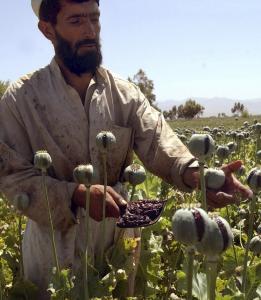
The last few years have seen a dramatic loss of momentum for coalition forces, as efforts to lessen opium production have failed to progress. The question has always been, what can rural farmers be sold on farming besides poppies? Well, it appears that cannabis has become popular as well -- not exactly what we had in mind.
Meanwhile, "rising food prices in Afghanistan are creating a crisis that is so far silent but that could manifest itself in urban riots, increased recruitment to the insurgency, and increased planting of both opium poppy and cannabis to earn cash incomes to buy food at the higher prices."
What's particularly painful about the current food shortage is that it represents possibly the biggest missed opportunity in Afghanistan. "Many factors are contributing to the rise [in agricultural prices], but the biggest is runaway demand. In recent years, the world’s developing countries have been growing about 7 percent a year, an unusually rapid rate by historical standards."
This demand increases the incentive for Afghan farmers to grow wheat instead of poppies, but alas, to no avail.
Why?
The Afghan government, which lacks economic expertise and administrative capacity in rural areas (to say the least) has proposed some kind of support for wheat farming to compensate for the food shortages and take advantage of the rising prices, which appear to be a long-term trend. Currently Afghan farmers are poorly positioned to take advantage of the wheat price rises, as traders monopolize most of the profit, as they do with poppy and cannabis. The World Bank vetoed such a program for the usual reasons (distorting markets, etc.) many of which are valid -- in addition to the fact that the Afghan government could not administer a complex and wasteful program like US agricultural price supports, especially since Afghan cultivators have no political influence.
Nonetheless, the rise in price in wheat and other commodities (what is happening to horticultural commodities, flowers, essential oils, and so on?) presents an opportunity for investing in other cash crops and their marketing in Afghanistan. For all the rhetoric about how the drug economy is supporting insurgency and terrorism, where is the program to seize this market opportunity? And for all the talk of the importance of Afghanistan to global security, where is the program to assure Afghans of an affordable supply of basic food? This would do at least as much good as more NATO troops, and with less risk of collateral damage (market distortion versus killing civilians).
The No. 1 takeaway from our experience in Iraq is that we must engage not only militarily, but economically and politically. The lack of a sufficient economic program is certainly not helping.
Read more!
Saturday, March 8, 2008
Turkey: Where Islam and the West get along OK

Besides being a future vacation destination for one, Publius Publicola, Istanbul has long been
a nexus of the Western, Eastern, and Middle Eastern worlds, and continues that role today as the birthplace of a global Muslim network (referred to as Gulenists, after their leader, Fethullah Gulen) directed by a firm belief in "science, inter-faith dialogue and multi-party democracy."
It's interesting that the Muslim movement has played the role of counterweight to Turko nationalism locally, while serving as an extension of Turkish influence abroad, from Central Asia to Iraq.
This pragmatic counter-reformation has the potential to play a positive role in some of the most fragile nation-states in the world. "As a global force, the Gulenists are especially active in education. They claim to have founded more than 500 places of learning in 90 countries."
“If you meet a polite Central Asian lad who speaks good English and Turkish, you know he went to a Gulen school,” says a Turkish observer.
...
Compared with all these [other Muslim] groups, the Gulen movement offers a message to young Muslims that sounds more positive: it tells them to embrace the Western world's opportunities, while still insisting on Islam's fundamentals
Good news.
Read more!
Tuesday, February 26, 2008
What would Obama's military look like?
Along with economics, one of my major considerations in the upcoming election will be each candidate's foreign policy approach, which, by extension, includes the military.
Military fears 'unknown quantity'
Members of Washington's military and defense establishment are expressing trepidation about Sen. Barack Obama, as the Illinois senator comes closer to winning the Democratic presidential nomination and leads in national polls to become commander in chief. But his backers, including a former Air Force chief of staff, say the rookie senator believes in a strong military, and with it, a larger Army and Marine Corps.
...
Lawrence Korb, a military analyst at the Center for American Progress and one of a dozen or so national security advisers to the Obama campaign, rebutted the lack-of-experience complaint, saying neither President Bush nor John F. Kennedy could claim an extensive national security background before entering the White House.
...
But Loren Thompson, who runs the Lexington Institute and stays in touch with defense industry executives, said Mr. Obama is difficult to categorize.
"His views are all over the map depending on whether its nuclear proliferation, energy independence or the global war on terror," he said. "How many liberals say they are going to bomb al Qaeda in Pakistan no matter whether the Pakistanis like it or not? He's much harder to pin down."
The Kennedy comparison doesn't quite inspire confidence in me, given his early blunders (though it's better than a Carter comparison, which haunts me). But I think the final selection reveals the real mystery of what Obama would do. He is indeed hard to pin down. Read more!Sunday, February 24, 2008
Foreign Policy's 2007 Failed States Index
 Not exactly "current," but an ambitious index with all sorts of goodies, like which failed nation-states took a turn for the better (or worse). An excerpt:
World leaders and the heads of multilateral institutions routinely take to lecterns to reiterate their commitment to pulling vulnerable states back from the brink, but it can be difficult to translate damage control into viable, long-term solutions that correct state weaknesses. Aid is often misspent. Reforms are too many or too few. Security needs overwhelm international peacekeepers, or chaos reigns in their absence. The complex phenomenon of state failure may be much discussed, but it remains little understood. The problems that plague failing states are generally all too similar: rampant corruption, predatory elites who have long monopolized power, an absence of the rule of law, and severe ethnic or religious divisions. But that does not mean that the responses to their problems should be cut from the same cloth. Failing states are a diverse lot. (Read on)

 Posts
Posts


